


Athens » Ancient Athens
More about Athens & Attica
AthensAncient Athens
Ancient Agora
Museums
Walks in Athens
Plaka
Syntagma area
Lycabettus
Entertainment
Nightlife
Shopping
Excursions
Athenian Riviera
Mount Parnitha
Kaisariani Monastery
Daphni Monastery
Marathon
Piraeus
Porto Germeno (Aegosthena)
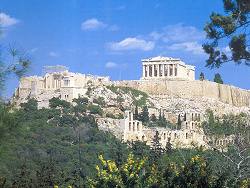
Acropolis - For thousands of years the Acropolis has been the symbol of Athens, the sacred rock, the link that connects the magnificent ancient civilization with the modern. The Acropolis and its monuments, its history and the myths that are connected with it are rightly the pride and the glory of this city, the envy of all other cities in the world. There is no Greek or foreign visitor who does not want to make the pilgrimage to the sacred rock and absorb its magnificence and beauty. If you have never been to the Acropolis we assure you it is a unique and unforgettable experience.
The Ancient Theatre of Dionysos - Pass through the entrance to the archaeological site at the southern slope of the Acropolis in Dionysiou Areopaghitou Street and start climbing. On your left you will see the oldest of all known theatres in the world, the theatre of Dionysos. Here, the four greatest ancient Greek poets, Aeschylos, Aristophanes, Euripides and Sophokles, saw their plays being performed for the first time, in the 5th century BC. The koilon (cavea) and the proskoinion (stage) were originally of wood. They were reconstructed of marble during the 4th century B.C. Today only parts of the stone koilon have survived. Experts estimate that the theatre could accommodate 17,000 spectators.
The Stoa of Eumenus - On your ascent you will find the Stoa of Eumenes, which was built by the King of Pergamon, Eumenes II, in the 2nd century B.C. Its main purpose was to protect the spectators in case of bad weather or sun. On passing through the Stoa you can see the ruins of the Asklepieion which was built in 429 B.C. after the plague that decimated the population of Athens.
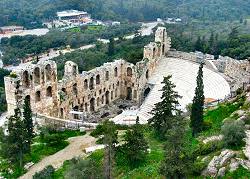
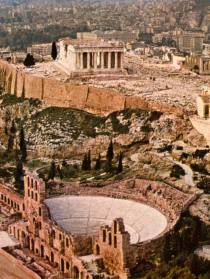
The Odeion of Herodes Atticus - (3d picture on the right) - The Herodeion as it is called by modern Greeks, was built in AD161 by Tiberius Claudius Atticus Herodes, an important figure of his time. He was a teacher and philosopher who had inherited a great fortune from his father. When his wife Rigilla died, he built this roofed Odeion for musical performances to honour her memory. The ancient Greeks used to give music and recital concerts there. Today the Athens Festival takes place at the Odeion every summer, but the Herodeion's splendour is best admired during a morning stroll on your way to the Acropolis.
The Sacred Rock - The Acropolis you see today dates from the Sth century B.C., when Athens set the tone for civilization in Europe. On the sacred rock of the Acropolis the monuments date from the prehistoric period to the end of antiquity.
The Propylea - This is the glorious entrance to the Acropolis and its monuments, constructed as part of the Perikles programme. The Propylaea, erected between 437 and 432 BC, were the work of the famous Athenian architect Mnesikles.
The Temple of Athena Nike (Apteros Nike) - This temple was erected to the south of the Propylaea. about 420 BC, to commemorate the victories of the Greeks over the Persians. The architect of this temple was Kallikrates.This place is so unique that there has been a temple on this exact spot since prehistoric times. On the left is the Erechtheion and straight ahead the Parthenon.
The Parthenon - The Parthenon is the unique masterpiece of the world. You will realise it yourself the moment you stand in front of it and learn a little of its history and the secrets of its construction. The beauty, harmony and grace of this monument make a really lasting impression on everyone who sees it. Today admission to the Parthenon is prohibited due to the restoration work that has been taking place there since 1983. This will not prevent you from admiring this unique temple dedicated to the goddess Athena and built of white marble from Penteli. Under the Parthenon of the Classical times there are remains of the monumental Ur-Parthenon, an Archaic temple dated in the late 6th century B.C. The architects of the Classical temple, which was constructed and decorated between 447 and 432 B.C. during the Golden Age of Perikles, were Iktinos and Kallikrates. The Parthenon housed the golden-ivory statue of Athena, work of the famous sculptor Pheidias. This statue was the final destination of the Great Panathenaea procession, depicted on the frieze of the temple.
The Golden Ivoty Statue of Athena - A statue ten metres high which stood inside the Parthenon. The interior was of wood and the naked parts made of ivory. The dress and the helmet were made of hammered plates of gold which could be removed. The statue which represented the goddess Athena, armed and holding a two- metre high ivory statue of Nike (Victory) in her right hand, was lost during the first years of the Byzantine period. Our knowledge of its existence comes from ancient sources and the traveller Pausanias' detailed descriptions (2nd century AD). Valuable information about the statue has been obtained also from the copies found, of which the most famous is the Varvakeion Athena.
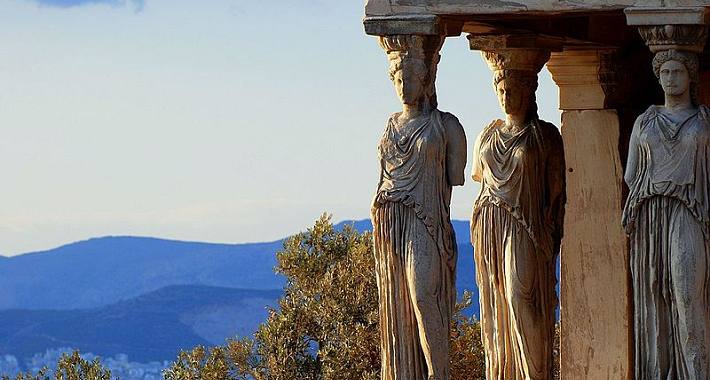
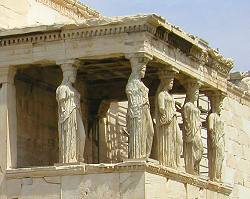
The Erechtheion - The Erechtheion was built in 420-406 B.C. on that part of the Acropolis held to be the most sacred; the place where the goddess Athena had caused her most sacred emblem, the olive tree, to sprout. This tree was destroyed in later years by the invading Persians. But when the Persians were finally driven off, legend has it, that the tree miraculously grew again. The Caryatids: the figures of maidens that you see supporting the roof of the south porch of the temple are copies.
The Areios Pagos - It is the most ancient court of law, a place much respected in ancient times. Here was the seat of the first aristocratic parliament of ancient Athens. In time this parliament started to lose its political power and from the second half of the 5th century BC it had only judicial responsibility and particularly that of trying murderers. In this court, as is described in Oresteia, Orestes was judged for the murder of his mother Clytaemnestra and her lover Aegisthos. It was from this spot, as we learn from the bronze tablet at the base of the rock, that saint Paul delivered his first sermon to the Athenians, in AD 51.
The Pnyx - The Pnyx is situated between the Hill of the Muses, upon which stands the Monument of Philopappou, and the Hill of the Nymphs, where the tomb of Kimon was found and where the Observatory stands today. This semi-circular area was the place of gathering for all the citizens of ancient Athens. They gathered here in order to hear the famous orators who spoke from the stone-cut tribune in its middle. It is believed that it could accomodate up to 10,000 people at a time.
The Panathenea Feast - Every year ancient Athenians celebrated the Mikra Panathenaea (lesser), and every four years the Megala Panathenaea (Great), which were more magnificent still and which included contests in equestrian skill, athletics, music and other arts. On the last day a procession started from Kerameikos, passed through the Agora and climbed to the Acropolis to offer Athena her so called peplos (vestment). In those days it was customary to dress statues in real clothes. Thus the peplos of the goddess was in fact a real woollen dress, hand-woven by a priestess and the young virgin girls who helped her. It was placed as a sail on the mast of a big wooden vessel and was brought to the Acropolis. The whole procession followed the ship. This is the procession sculpted on the frieze of the Parthenon.
More about Athens & Attica
Walks in Athens » Plaka • Syntagma area • Lycabettus
Entertainment » Nightlife • Shopping
Excursions » Athenian Riviera • Mount Parnitha • Kaisariani Monastery • Daphni Monastery • Marathon • Piraeus • Porto Germeno (Aegosthena)

The travel guide to Greece


Contact: contact@thegreektravel.com Last update 26 April 2019