


Walks in Athens » Plaka
More about Athens & Attica
AthensAncient Athens
Ancient Agora
Museums
Walks in Athens
Plaka
Syntagma area
Lycabettus
Entertainment
Nightlife
Shopping
Excursions
Athenian Riviera
Mount Parnitha
Kaisariani Monastery
Daphni Monastery
Marathon
Piraeus
Porto Germeno (Aegosthena)
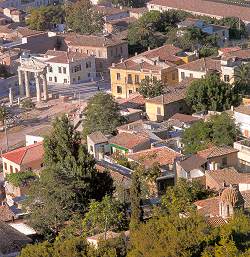
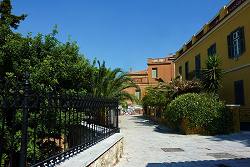
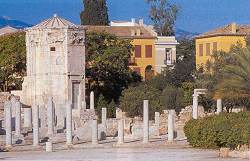
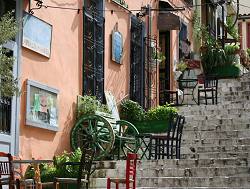
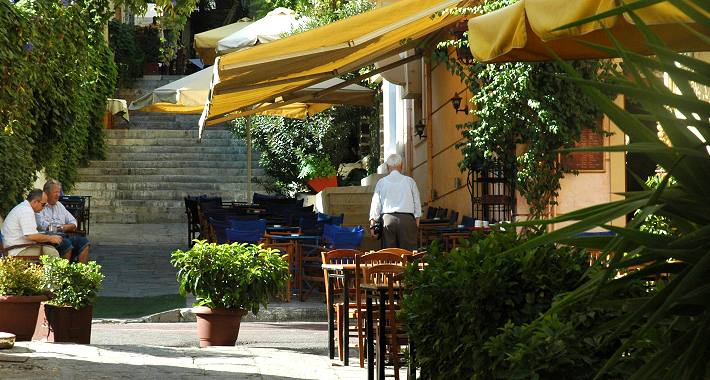
Plaka - As soon as you start walking around Plaka's stone-paved, narrow streets, you will have the feeling that you are traveling back in time.
This is Athens oldest and, thanks to the restoration efforts which went into its buildings in recent years, most picturesque neighborhood.
You will be delighted by the beauty of the neo-classical colors of its houses, their architecture, their lovingly tended little gardens, the elegance, and the total atmosphere of the area.
In Plaka, even the air is different; lighter, clearer, scented, like a gift from the gods.
When you decide to take a walk around it be sure to bring a map along, because Plaka is a labyrinth and you may get the feeling that you are lost in its maze of narrow streets and alley ways. No need for alarm though. It is easy to orientate yourself: uphill is the Acropolis and downhill are Syntagma and Monastiraki.
What does Plaka mean - The origin of the area's name is not really known thus allowing various theories to have developed concerning it. According to the most recent one, Plaka owes its name to a large stone slab (plaka in Greek) found in the area of the church of Ayios Georgios of Alexandria near the ancient theater of Dionysos.
Philomousou Etairias Square - Plaka's central square was named after the Philomousos Etairia (Meaning Friends of the Muses namely the 9 patron goddesses of the Arts) which was founded in 1813. Its aim was to encourage Greek-oriented studies and the preservation of the archaeological treasures of Athens. You will find the square at the crossroads of Kydathenaeon, Farmaki, Olympiou Dios and Anghelou Geronda Streets. The square is full of cafes, restaurants, bars and night clubs. You will also find many shops selling souvenirs: miniatures and copies of well known works of ancient Greek art, jewellery of traditional Greek design, Komboloya (worry beads) and stamped T -shirts.
Walking along Kydathenaeon Street - The Children's Museum A child's paradise. In its attic you can see a reconstructed room complete with old furniture, radio and heater of an old Athenian house. It IS appropriately called the "grandmother and grandfather room" and in it children can dress up in period costumes. On the first floor there is a reconstruction of the worksite of the Athenian metro, which is currently being extended all over the city. Here the children get an idea of what the future metro stations are going to look like and can enter a tunnel wearing a workman's helmet. The Museum also houses a playground and a library. If you have a child, this is a stop you cannot afford to miss.
Towards the Roman Market - The Tower of the Winds Just outside the eastern side of the Roman Agora, you will come across an octagonal monument. This is Andronikos Kyristes' clock, -(second picture)- built during the 1st century B.C., which housed an hydraulic clock. Each of its eight sides was decorated with representations of the eight winds. That is why the monument was nicknamed Aerides (winds).
Towards the Acropolis - The Monument of Lysikrates In ancient Athens the staging of theatrical performances in the theatre of Dionysos was sponsored by wealthy citizens, called choregoi. The choregos who sponsored the best performance of the year, was presented with a prize by the city. When wealthy Lysikrates won the prize (334 B.C.), he decided to build a monument to house it where it remains to this day. Its construction by Lysikrates was only the beginning of the monument's long and eventful story. In 1658, a Capuchin monastery was founded here by French friars of that order and in 1669 the monument was bought by them. It was in this monastery that Lord Byron stayed during his second visit to Greece. It was in its gardens that in 1818 the first tomato plant in Greece grew, after Father Francis brought the seeds from abroad. In 1829 a foreign traveller in Greece was granted permission by the friars to take the monument with him, but fortunately it proved too heavy for him. Later, Lord Eigin put his mind to the same task but was again stopped, this time by the monks.
Near Plaka
The Olympieion -
According to the traveller
Pausanias, the temple of Olympian
Zeus was founded by Deucalion,
one of the mythical ancestors
of the Greeks. Around 515 BC,
the Peisistratids, one of the
dynasties of tyrants (absolute
rulers) of ancient Athens,
endeavoured to replace the old
temple with a new, more
impressive one. But tyranny was
abolished and the construction
was halted. The construction of
the temple was resumed by the
Roman architect Decimus
Cossutius employed by Antiochos
IV Epiphanes, King of Syria. When
Antiochos died in 163 B.C. the
temple was once more
abandoned without a roof and
pediments, and it was finally
completed by the Roman Emperor
Hadrian in AD 131.
The Arch of Hadrian -
After the construction of the
temple of Zeus, the Athenians
honoured Hadrian by building, in
AD 131 an arched gateway in the
north-west corner of the enclosure
of the temple. The arch, built of
Pentelic marble (Penteli is one of
the mountains surrounding the
basin of Athens), bears two
inscriptions. The one on the side
facing the Acropolis (west facade)
reads: This is Athens, the ancient
city of Theseus while the other, on
the side facing the sanctuary and
the extension of the city by
Hadrian, reads: This is the city
of Hadrian and not of Theseus.
More about Athens & Attica
Walks in Athens » Plaka • Syntagma area • Lycabettus
Entertainment » Nightlife • Shopping
Excursions » Athenian Riviera • Mount Parnitha • Kaisariani Monastery • Daphni Monastery • Marathon • Piraeus • Porto Germeno (Aegosthena)

The travel guide to Greece


Contact: contact@thegreektravel.com Last update 26 April 2019