


Walks in Athens » Syntagma (Constitution) Area
More about Athens & Attica
AthensAncient Athens
Ancient Agora
Museums
Walks in Athens
Plaka
Syntagma area
Lycabettus
Entertainment
Nightlife
Shopping
Excursions
Athenian Riviera
Mount Parnitha
Kaisariani Monastery
Daphni Monastery
Marathon
Piraeus
Porto Germeno (Aegosthena)
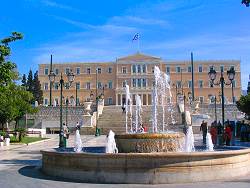
1st - Syntagma - House of Parliament
2nd - Syntagma Square
3rd - Syntagma Square
and the House of Parliament
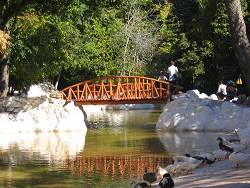
4th - National Garden
5th - National Garden
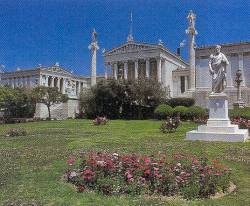
6th - The Academy of Athens
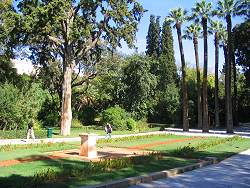
7th - National Garden
8th - Zappeion
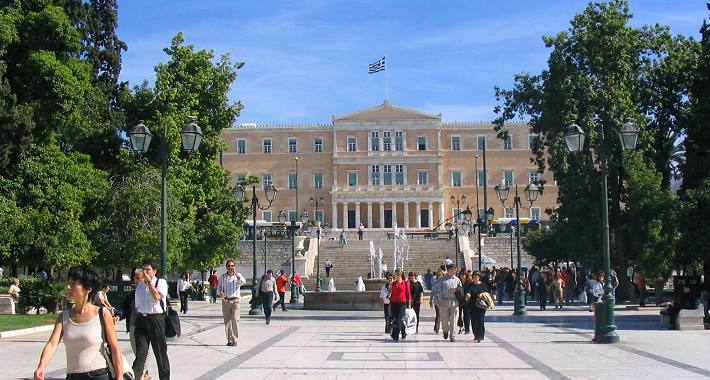
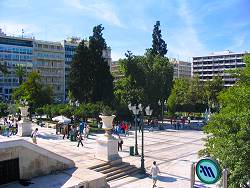
Syntagma (Constitution) Square - It is, together with Omonoia Square, one of the two points of reference of this city. So, do not be surprised if you keep hearing the word Syntagma (which means Constitution), when you ask for directions in Athens. Plaka, the Acropolis, the Cathedral of Athens, the National Garden, the Byzantine church of Kapnikarea, Ermou Street (one of the main commercial streets of the city), even Kolonaki Square, are all near Syntagma.
The House of Parliament and the Tomb of the Unknown Soldier, where the spectacular changing of the guard takes place every hour, are actually in it. Syntagma Square is the centre of all activity. The buildings surrounding the square itself house hotels, Greek and Street (one of the main commercial streets of the city), even Kolonaki Square, are all near Syntagma. The House of Parliament and the Tomb of the Unknown Soldier, where the spectacular changing of the guard takes place every hour, are actually in it. Syntagma Square is the centre of all activity. The buildings surrounding the square itself house hotels, Greek and foreign banks, ministries and airline offices. Some of the trendiest bars and night clubs, which are open only during wintertime, are to be found here too. The square never sleeps. In its kiosks, you will find all manner of things, ranging from aspirin to Greek souvenirs, as well as all the major foreign newspapers and magazines.
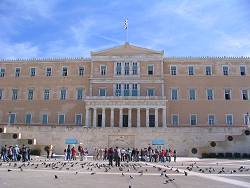
The House of Parliament -
It overlooks Syntagma Square and
was originally built as a palace for
King Otto, the first King of Greece
and Queen Amalia.
Its construction took six years,
from 1836-1842. The second King
of Greece, King Georgios, also
lived in this palace. But during his
reign two serious fires destroyed
the building to the extent that it
was judged unfit for royal
occupation. It was in 1924 that the
government decided to house the
Greek Parliament in the building.
Renovation work finished in 1934.
The interior of the building was
redesigned by the architect A.
Kriezis. The Tomb of the Unknown
Soldier, in the front of the building,
was built in 1929-1930.
This monument where Greek ,
officials and visiting dignitaries lay
wreaths on major holidays, is
guarded day and night by a pair of
elite soldiers called Evzones. The
changing of the guard every hour
Ioffers onlookers a very
spectacular event. You can visit
the Parliament House, which
keeps precious national treasures
like the First Greek Constitution
and many valuable paintings. Also
worth visiting is the Parliament's
large library.
Kolonaki Square - the trendiest - One of the things you must do when you are in Athens is have a cup of coffee in one of the coffee shops in Kolonaki Square. To have spent a few hours eating, drinking and just chatting in one of this square's coffee shops, is a prerequisite for trendy Athenians and foreign visitors alike. Kolonaki also offers some of the best shopping in town, some of the best organised and biggest kiosks (periptera) in the city and some very interesting walks around its busy streets.
The National Garden -
Open dawn to dusk. An oasis in
the middle of the city. An area
of almost 40 acres full of flowers,
plants, bushes and trees from
all over the world. Five hundred
different varieties of plants under a
canopy of trees. Designed to be the
garden of the Royal Palace of King
Otto and Queen Amalia, it was
planted between 1838 and 1860.
You can enter the garden from
one of four gates: the central one,
on Vasilissis Sophias Avenue,
another on Herodou Atticou Street
and the third on Amalias Avenue.
The fourth gate connects the
National Garden with the
Zappeion park area. Wander
along the pathways, listen to the
birds, sit on a bench and relax. In
the National Garden you will find:
a duck pond, a small zoo,
a Botanical Museum, a small cafe,
and a Children's Library and
playground.
Zappeion - The Zappeion is the small park area between the National Garden and the Olympieion. In it you will see the handsome Zappeion Megaron, designed by the architect Theofil Hansen and built in 1874-1888. In recent years this "Congress and Exhibition Hall", has witnessed some of the most important moments in this country's modern history: European leaders' summits, election day results and important political announcements. It also houses important art exhibitions and occasionaly concerts are given here.
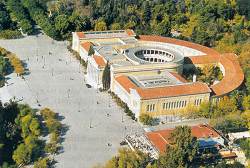
The Panathinaikon Stadium - A really impressive sight, built of white marble in the shape of a horseshoe, it stands opposite the National Garden. The first Stadium to be built on this site was constructed of wood in 330 B.C. The marble structure, of which the present day Stadium (Stadio) is a faithful replica, was built by Herodes Atticus. It was used as a venue for the athletic games held during the feast of Panathenaea, hence its name Panathenaikon. The Stadium we see today was built between 1869 and 1870 for the first Olympic Games held in modern times in 1896.
The three temples of learning -
In Panepistimiou Street there are
three buildings, which were built
at approximately the same time, in
the decades after Independence.
They were designed by the
Hansen brothers, two famous
Danish architects who lived
in Greece at the time.
The University (1839-1864) -
The Athens University was
designed by the elder brother.
Hans Christian Hansen and its
construction began in 1839.
Notice the graceful fountain in its
courtyard. its circular staircase
and the colourful frescos of
classical subjects, which adorn
the walls behind a row of columns
in its porch. The frescos were
painted by the Bavarian Karl Rahl.
The Academy (1859-1887) -
The Academy of Athens is flanked
by two wings decorated with
friezes and a pair of tall columns
adorned by statues of Apollo and
Athena. It was designed by the
younger brother Theofil Hansen.
The statues are the work of the
sculptor L. Drosis and the painted
decorations were again done
by Karl Rahl. The Academy is
considered the finest example
of the Greek order in architecture.
The National Library (1887-1902) -
Yet another wonderful building,
designed by the younger brother
Theofil Hansen. It is the largest
library in the country housing
thousands of books in all
languages. Theofil Hansen first
started designing this simple,
stately building in 1858 and
concluded it in 1884.
More about Athens & Attica
Walks in Athens » Plaka • Syntagma area • Lycabettus
Entertainment » Nightlife • Shopping
Excursions » Athenian Riviera • Mount Parnitha • Kaisariani Monastery • Daphni Monastery • Marathon • Piraeus • Porto Germeno (Aegosthena)

The travel guide to Greece


Contact: contact@thegreektravel.com Last update 26 April 2019