


Magnesia » Volos, the capital
More about Pelion & Magnesia
Magnesia PrefectureHotels
Touring Pelion
Volos - The Capital
History
Snow ski centre
The steam train
Pelion Seaside villages
Agios Ioannis
Afissos
Damouhari
Horefto
Horto
Kala Nera
Kalamos
Kato Gatzea
Milina
Mylopotamos
Papa Nero
Platanias
Trikeri Island
Pelion Mountain Villages
Agios Dimitrios
Argalasti
Kissos
Makrynitsa
Milies
Hania
Pinakates & Visitsa
Portaria
Tsagarada
Xourihti
Zagora
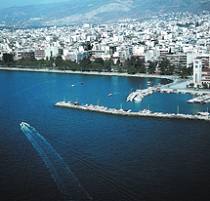
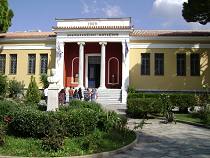
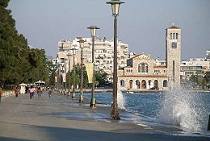
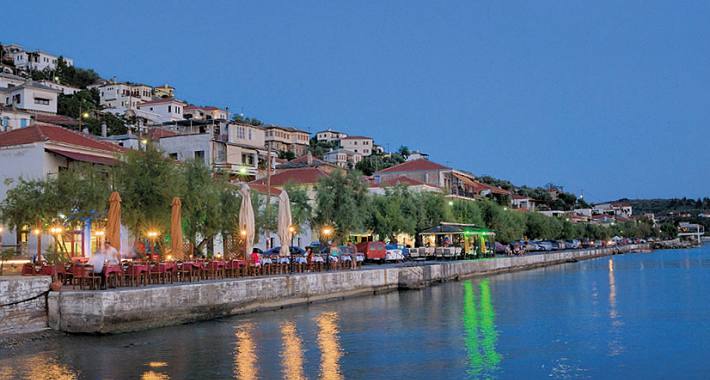
Volos -140,000 inhabitants - (326 km.from Athens, 215 km. from Thessaloniki) is the capital and economic centre of Magnesia prefecture thanks to its privileged position at the foot of Mountain Pelion on the Pagasitic Gulf, it is a ideal place for enjoying the sea, wooded slopes and green valleys that surround it. As for the derivation of the word "Volos", which according to a Byzantine historian of the 14th century was called "Golos", there are several theories; the most widely accepted is that it represents a corruption of the Mycenaean lolkos. Founded in the mid 19th century, modern Volos, is a cheerful, lively town, soundly laid out with pleasant broad streets. The waterfront is an ideal spot for a stroll. A modern coastal avenue busting with life, it is lined with pastry shops, cafes and restaurants.
The local theatre always has concerts of jazz music, guitar, classical concerts, great performance, painting exhibitions and dancing shows. In the daytime cheerful restaurants and taverns compete for your time with shops, the museum and the parks. Volos is particularly known for its «tsipouradika», small charming places set in a marine environment, where you can sip the local «tsipouro» (spirit) and taste the delicious «mezedes» (appetizers). There are up to 300 «tsipouradika» (places where you can drink tsipouro spirit with appetizers) spread throughout the town and along the harbour, serving fresh fish and a great variety of shellfish. At night, clubs and bars bring a lovely atmosphere to the city.
In Volos museum, visitors have the opportunity to admire the great selection of prehistoric findings such as: ceramics, pottery, clays statues, stone implements and weapons. Exhibits from the classical and Roman period are also on display. It is worth seeing the remains of the old city of Dimitriados in Pagases, some 6 km outside of Volos. Apart from the impressive exhibits found in this town there are excellent places to visit. There is a huge green park lying across the harbour where you can go for strolls by the sea.
From the suburb of Ano Volos, built up the slopes of Pelion, the Pagasitic gulf and the town below take on another dimension. Volos harbour is particularly active.
Around Volos
The lush area around Volos scattered with
interesting archaeological sites which history
buffs will find very rewarding.
West of Volos taking the Volos - Larissa
National Road, a small detour will lead you
to one or more of the various archaeological
sites in the vicinity: the prehistoric settlement
of Dimini (6.5km) with a ruined acropolis,
walls and two beehive tombs dated to
between 4000 -1200 BC; Sesklo (13.5km)
with the remains of the oldest Acropolis in
Greece (6000 BC), as well as the foundations
of a palace and mansions among
the most typical examples of neolithic civilisation.
A bit further to the west lies the
village of Velestino (17km), birthplace of the
revolutionary poet Rigas Ferraios, built on
the site of the ancient city of Pherai.
Southwest of Volos
Near the coast road heading southewest
of Volos, you will spot a pine wooded area
containing the ruins of ancient Dimitrias
(4km), the important city founded by
Dimitrios Poliorkitis in the 3rd century BC.
In this particular extensive archaelogical
site there are ruins of a temple, palace and
theatre with incomparable acoustics.
Portions of the city's circuit wall can be
seen on a hill to the right of the road. The
famous grave pillar adorning the
Archaeological Museum in Volos were discovered
in the towers still standing on the
acropolis. A little to the east, at Pefkakia,
are the scant remains of a Mycenaean
settlement identified as the Homeric city of
Neleia .The road then passes by Nees
Pagases (5km), a summer resort today with
good facilities for tourists built on the site of
ancient Pagasai, an eminent commercial
centre of the Sth century BC and port of
ancient Pherai.
Finally the village of Kanalia (26km) surrounded
by almond trees is well worth of
visit. Every March there is an almond
blossom festival. Here also there is a thriving
bronze handicraft industry.
Maratho (13km) and Chrysi Akti (15km)
further south are renowned for their
crystalline waters and the fresh fish served
in their taverns. The main road continues
along the shore, passing Nea Anhialo
(18km), a pleasant market town built in a
fertile region in a position formerly occupied
by Ancient Pyrassos, which together
with the neighbouring city of Phthiotic
Thebes was the most important commercial
centre on the Pagasitic gulf. Its small museum
contains neolithic and early Christian
finds.Continuing on you come to
Mikrothives (25km) which took its name
from Phthiotic Thebes. There are ruins of
the old city -walls, temple, theatre and a
stoa- on the nearby hill. At Almiros (35km),
the centre for animal husbandry and farming
in the area, you can visit the
Archaeological Museum, while the Kouri
park, the ruins of ancient Alos and the
monastery of Panagia Xenia at Orthris are
worth a visit.
The seaside village of Amaliapolis (57km) near Cape Almiros is very popular holiday spot.One of the largest villages in the Almiros area is Sourpi, surrounded by bountiful olive groves.lts taverns serve delicious "kokoretsi", a treat made of liver, spit roasted on glowing coals. As you proceed along the coast road, which cuts through the southern section of Magnesia past extraordinarily picturesque scenery, it is worth stopping at Pteleos (60km), a historic village with more olive groves, and its port, Pigadi, a quiet fishing hamlet with sparkling waters and an abun- dance of fresh fish; at Ahilio (67km), an idyllic bay with a long beach, and an ideal sanctuary from the August heat.
More about Magnesia & Pelion
Pelion Seaside villages » Agios Ioannis • Afissos • Damouhari • Horefto • Horto • Kala Nera • Kalamos • Kato Gatzea • Milina • Mylopotamos • Papa Nero • Platanias • Trikeri Island
Pelion Mountain Villages » Agios Dimitrios • Argalasti • Kissos • Makrynitsa • Milies • Hania • Pinakates & Visitsa • Portaria • Tsagarada • Xourihti • Zagora

The travel guide to Greece


Contact: contact@thegreektravel.com Last update 26 April 2019